
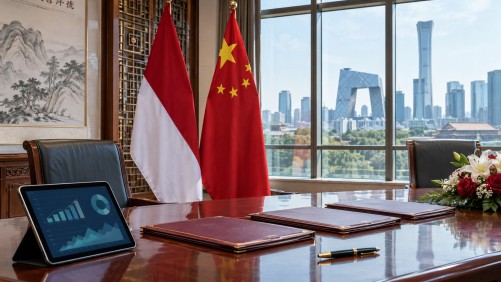
Indonesia has sealed potential economic cooperation agreements totaling $86.8 billion following President Prabowo Subianto’s visit to China in November 2026. These agreements are anticipated to enhance bilateral trade, draw in investment, boost industrial production, and accelerate technological growth between the two nations.
A significant portion of these commitments came from the signing of 35 memorandums of understanding (MoUs) valued at approximately $15 billion during the Indonesia-China Business Forum in Shenzhen on November 20. This is in addition to the previously announced $71.8 billion in economic agreements during the presidential visit. The agreements span various strategic sectors such as renewable energy, petrochemicals, manufacturing, electric vehicles, digital technology, data centres, pharmaceuticals, infrastructure, and industrial development.
The partnership underscores Indonesia’s strategic shift towards strengthening its domestic manufacturing base, moving beyond the mere export of raw materials. Investment priorities include mineral processing, energy security, digital infrastructure, biotechnology, and logistics. The proposed projects are expected to create over 30,000 jobs in Indonesia, fostering technology transfer, workforce development, and higher-value industrial production.
China, being Indonesia’s largest trading partner and a significant source of foreign investment, plays a crucial role in this partnership. In the first nine months of 2026 alone, bilateral trade amounted to approximately $132.13 billion, with Indonesian exports at $55.47 billion and imports at $76.67 billion. In 2025, Chinese investment in Indonesia was about $7.5 billion, highlighting China’s pivotal role in Indonesia’s economic landscape.
Focusing on mineral processing and renewable energy, Indonesia seeks foreign investments to support domestic industries. Notable initiatives include the development of an integrated electric vehicle battery ecosystem by the ANTAM-IBC-CBL consortium and solar cell manufacturing operations by Trina Solar in Central Java. In the natural gas sector, Wison New Energies is involved in developing a floating liquefied natural gas facility in West Papua.
Beyond these agreements, several large-scale projects were highlighted, including a $50 billion smart city development plan by PT Kota Masa Depan Indonesia and a Chinese consortium, and a $10 billion investment from Hisense to expand its operations in Indonesia. Additionally, a $10 billion infrastructure financing commitment was made between Indonesia’s Danantara and China’s State Development and Investment Corporation.
While these agreements represent a significant advancement in Indonesia-China economic relations, turning these commitments into tangible economic growth will require consistent government support, transparent regulations, and a skilled workforce. The aim is to not only enhance Indonesia’s manufacturing capabilities but also ensure sustainable benefits through technology transfer and adherence to environmental standards.